Rawal Pindi
The Jungle BookRawal Pindi is presented as the site of a vast military gathering where rain, mud, animals, weapons, and imperial authority occupy the same crowded landscape. The place becomes more than a backdrop for ceremony: through the disorder of the camp and the precision of the review, it exposes how a colonial army turns a heterogeneous mass of people and working animals into an organized instrument of command.
Camp, Weather, and Disorder
Rawal Pindi is covered by relentless rain when thirty thousand men and thousands of camels, elephants, horses, bullocks, and mules assemble for a review by the Viceroy of India. The Viceroy is also receiving the Amir of Afghanistan, who has brought eight hundred men and horses from Central Asia; many of these horses have never encountered a camp or a locomotive. Their unfamiliarity produces nightly disturbances. Horses break their heel ropes and stampede through the mud, while camels escape, run among the tents, and fall over the ropes. The camp is therefore introduced not as a naturally orderly military machine but as a vulnerable, noisy environment in which animals can interrupt sleep, transport, shelter, and command.
One stormy night, the narrator is warned to leave quickly because the loose animals are approaching. The narrator escapes through the slush with Vixen, while a camel blunders into a tent, snaps its pole, and makes the collapsing shelter move like a mad ghost. Continuing through the darkness, the narrator reaches the artillery lines, finds a gun, and makes a temporary shelter from a waterproof and several rammers. A mule from a screw-gun battery then passes, identifiable by the harness, straps, rings, and chains around its saddle pad. The episode places military technology beside animal labor: the screw-guns are small cannon carried in two parts and reassembled for use in mountainous country, while the mule supplies the mobility that allows them to reach terrain inaccessible to heavier equipment.
The Military Review
The parade takes place after the rain has briefly given way to sunshine. Vixen and the narrator secure a position near the Viceroy and the Amir, and the assembled regiments pass in successive waves of synchronized legs and aligned guns. The cavalry follows to the music of “Bonnie Dundee.” The troop-horse of the second squadron moves with a controlled canter, one ear forward and one back, setting the pace for the entire squadron. The scene makes coordination appear almost musical: individual bodies remain visible, but their value in the parade depends upon their submission to a shared rhythm.
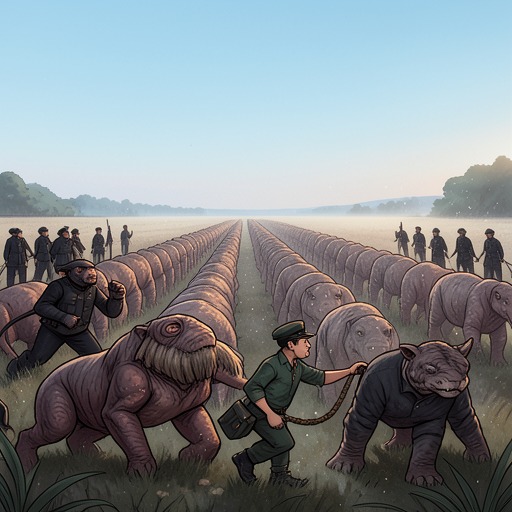
The heavy equipment reveals another layer of Rawal Pindi’s military organization. Two Tails and two other elephants draw a forty-pounder siege gun, followed by twenty yoke of oxen. The seventh pair has a new yoke and looks stiff and tired, a small physical sign of the labor concealed within the polished ceremony. The screw-guns come last, with Billy the mule carrying himself as though he commanded the troops and wearing harness that has been oiled and polished. The parade thus includes not only soldiers and officers but also animals whose strength, training, and bodily endurance make the army’s display possible.
Rain returns as the troops form a great half-circle and spread into a line three-quarters of a mile from wing to wing. The line advances directly toward the Viceroy and the Amir, and the ground trembles beneath the movement of men, horses, and guns. The Amir, who has shown no earlier astonishment, grows visibly alarmed and looks behind him as if he might draw his sword and force a way through the spectators. The advance stops, the formation salutes, and thirty bands play together. Rawal Pindi’s spectacle therefore depends on controlled menace: the same mass that could appear chaotic in the camp becomes frighteningly powerful when disciplined into a single movement.
Command and Obedience
The review’s political meaning is stated after the ceremony, when an old Central Asian chief asks a native officer how the extraordinary display was accomplished. The officer answers that an order was given and obeyed. He then describes a continuous hierarchy: the mule, horse, elephant, or bullock obeys its driver; the driver obeys the sergeant; the sergeant obeys the lieutenant; and authority proceeds through captain, major, colonel, brigadier, and general to the Viceroy, who is described as the servant of the Empress. Rawal Pindi is therefore represented as a place where command is not merely announced but transmitted through successive ranks until it reaches the bodies that move on the ground.
The exchange also contrasts imperial discipline with the political condition attributed to Afghanistan. The chief says that it would be desirable if obedience worked the same way there, because its people obey only their own wills. The officer replies that this is why the Amir, whom his own people do not obey, must come to take orders from the Viceroy. The review consequently functions as an argument about government. Its apparently decorative precision becomes evidence of administrative power, while the obedience of animals is deliberately placed within the same chain as the obedience of human soldiers.
Narrative Significance
Rawal Pindi gathers several recurring concerns of the surrounding animal narratives into one public scene. Animals are not silent ornaments: camels cause camp crises, the mule’s equipment identifies its military function, elephants draw siege artillery, oxen support the guns, and horses determine the cavalry’s rhythm. Yet the review also shows their incorporation into a hierarchy that treats their obedience as proof of institutional strength. Their skill and bodily effort are made visible, but their autonomy is subordinated to the system that deploys them.
The setting also links spectacle with the less orderly realities of service. The polished harness, straight lines, music, and salute conceal mud, exhaustion, broken ropes, frightened animals, and improvised shelter. In this contrast, Rawal Pindi becomes a compact image of imperial organization: its authority is persuasive because it can absorb confusion and produce synchronized action, but the material cost of that order remains present in the tired oxen, the rain-soaked camp, and the countless animals required to sustain the parade.